
Cold Plasma Explained and How It Differs from Conventional Air Purification
A plain-language guide to Cold Plasma (DBD) — from the basic science to how it compares with HEPA filters, UV-C, ozone and chemical sprays — in one article.
What Is Cold Plasma — and How Is It Different from HEPA Filters, UV, Ozone, and Chemical Sprays?
Short answer — for readers who want it now
What is Cold Plasma?
Cold Plasma is the fourth state of matter — after solid, liquid and gas. High voltage ionizes air molecules, producing reactive species such as superoxide, hydroxyl radicals and singlet oxygen that act directly on VOCs, odor and other volatile organic compounds in the air — with no heat, no filter and no added chemicals.
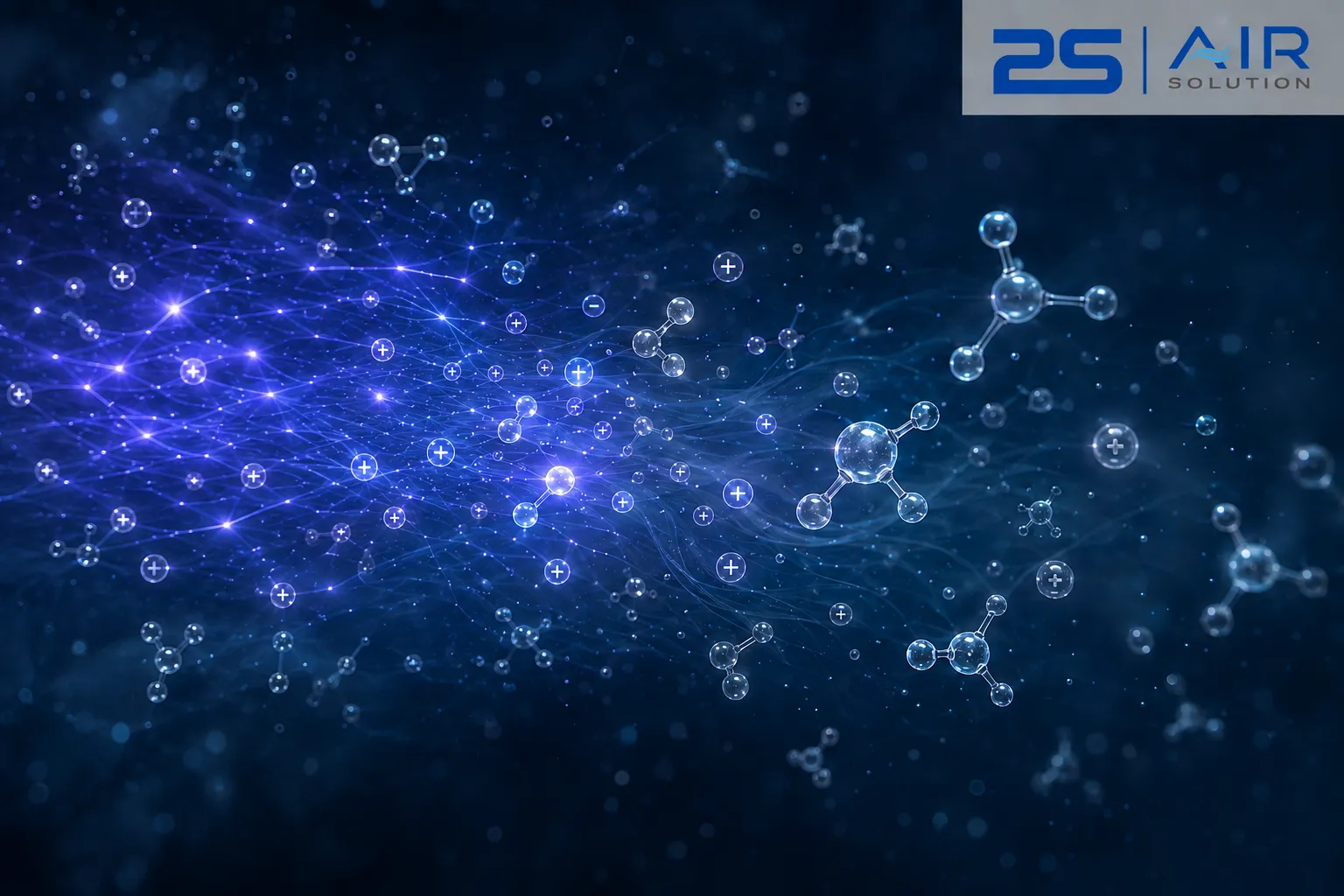
The fourth state of matter — the one we skipped in school
In school science we learn that matter has three states: solid, liquid and gas. But there is a fourth — the most common state in the universe — plasma.
In nature, plasma appears in the sun, lightning and the aurora — all extremely hot. But Cold Plasma, or non-thermal plasma, is plasma generated at close to room temperature using DBD (Dielectric Barrier Discharge) — the core of a new generation of air-hygiene technology.
Dielectric Barrier Discharge (DBD)
DBD applies high-voltage alternating current across an insulating (dielectric) material such as glass or ceramic, creating an electric field strong enough to ionize air molecules — without reaching thermal-plasma temperatures, because the dielectric limits the energy released.
The result is millions of microdischarges per second, producing reactive oxygen and nitrogen species (RONS) that disperse into the surrounding air — the “long arm” that reaches VOCs and odor molecules floating in the room.
The reactive species Cold Plasma produces — and what each one does
What sets Cold Plasma apart is that it produces several reactive species at once, each with a different mode of action:
- Hydroxyl Radical (OH)
Among the strongest oxidants. Oxidizes a wide range of VOCs and volatile organic compounds; very short-lived, acting close to where it is produced.
- Superoxide (O2)
A negatively charged oxygen ion that travels well in air and reacts with organic molecules over a wider area than hydroxyl radicals.
- Singlet Oxygen (1 O2)
A high-energy form of oxygen that reacts with certain VOCs and organic compounds other species do not reach.
O₃ - Ozone (by-product) (O3)
A small by-product. Well-designed DBD systems are engineered to keep it below the WHO guideline (~0.05 ppm, 8-hour average) according to the manufacturer’s test data in occupied spaces.
How is Cold Plasma different from an ozone generator?
An ozone generator relies on high concentrations of ozone (O₃) as its main mechanism and must be used in rooms empty of people and animals, because concentrated ozone irritates the airways. Cold Plasma (DBD) produces several reactive species at once — hydroxyl radicals, superoxide and singlet oxygen — with only a small, controlled amount of ozone as a by-product, so it is designed to run continuously in occupied spaces.
How it compares with other common air-treatment methods
To see where Cold Plasma stands out, it helps to understand how the other methods work — and where their limits are.
- HEPA Filter
Captures dust and fine particles (≥0.3 µm) on a mesh of fine fibres. Air must pass through the filter for particles to be caught.
Limitations Does not treat airborne VOCs/odor (molecules are smaller than the filter pores) · filters need replacing every 6–12 months · only treats air that passes through the unit - UV-C Light
UV-C light (100–280 nm) damages the DNA/RNA of microorganisms within the light’s reach. Used in AHUs or rooms with controlled exposure.
LimitationsActs only where the light shines, not on the whole room · directly harmful to skin and eyes · lamps lose output over their service life
- Ozone Generator
Produces high concentrations of ozone (O₃) to oxidize organic compounds and odor. Very effective on deep-set odors.
LimitationsRequires the space to be empty of people and animals · concentrated ozone irritates the airways · cannot run continuously
- Chemical sprays / disinfectants
Chemicals are sprayed to treat surfaces and air for a short time. They must be reapplied on a schedule, and some formulas have their own smell.
Limitations Temporary effect, ongoing repurchase · chemical smell may be unwelcome · does not continuously treat odor molecules floating in the air
Cold Plasma (DBD) — how it works differently from all of the above
How is Cold Plasma different from a HEPA air purifier?
A HEPA filter works passively — it captures dust only when air passes through the filter, and cannot treat VOCs or odor molecules suspended throughout the room because they are smaller than the filter pores. Cold Plasma works actively — it releases reactive species into the whole room without waiting for air to travel to the unit, treating VOCs and odor across the space. It does not capture dust particles as well as HEPA.
- Releases reactive species into the surrounding air instead of waiting for air to pass through the unit; coverage is sized by room volume (m³)
- Runs continuously 24 hours a day, including when no one is present — results build up over time
- No heat, and no harmful by-products at high levels when correctly designed
- No filters to replace — but the plasma tube (condenser) is rated about 8,000–14,000 operating hours — roughly every 1–1.5 years when running 24/7
- Installs as floor-standing or wall-mounted units, or inside existing air-conditioning (FCU/AHU) without tearing out the system
Comparison table — Cold Plasma vs. common methods
| Method / technology | Treats VOC/odor | Treats PM dust | Runs while occupied | Continuous 24h | Recurring cost |
|---|---|---|---|---|---|
| HEPA Filter | No | Excellent | Yes | Yes | Filters every 6–12 months |
| Activated Carbon Filter | Partly (adsorption) | No | Yes | Yes | Filters every 3–6 months |
| UV-C Light | No | No | Harmful to skin/eyes | Space must be closed | UV lamps every 1–2 years |
| Ozone Generator | Good (high concentration) | No | Must be unoccupied | Cycles only, not continuous | Low |
| Ionizer / Needle-Point | Little | Partly (settling) | Depends on model | Yes | Low |
| Chemical sprays / masking fragrance | Masks temporarily | No | Depends on chemical | Must reapply | High (ongoing purchase) |
| Acts on molecules directly | Partly | Yes (when correctly designed) | 24h continuous | Plasma tube 8,000–14,000 hrs |
Where can Cold Plasma be used?
Cold Plasma (DBD) suits spaces that need continuous air care while people are present — exactly where other methods fall short.
Pet hotels / veterinary clinics
Senior Care / Nursing Home
Office / Meeting rooms
Central Kitchens / Food Service
Hotels / Guest rooms
Schools / Children centers
Is Cold Plasma safe? Can it run while people are in the room?
DBD Cold Plasma built for air hygiene (for example, CE-marked European systems) is designed to run continuously in spaces occupied by people and animals: by-product ozone is engineered to stay below the WHO guideline (~0.05 ppm, 8-hour average) according to the manufacturer’s test data — provided the system is sized correctly for the room volume (m³).
2S Air Solution – Cold Plasma: Italian DBD technology for Thailand
The system 2S uses is DBD Cold Plasma manufactured in Italy by Skill Group Srl (Bioxigen®), CE-marked with an EU Declaration of Conformity, and designed for continuously occupied spaces — not just empty rooms.
Available as floor-standing and wall-mounted units (Tris / Miai / Globo — covering 40 m³, 100 m³ and 150–175 m³ per unit respectively) and as an in-duct unit for existing air-conditioning (Sanifan) in buildings with FCU/AHU systems. Exclusively distributed in Thailand by 2S Solution and Supply Co., Ltd.
Frequently asked questions
What is Cold Plasma, in simple terms?
Cold Plasma is the fourth state of matter, created when high voltage ionizes air molecules to produce reactive species such as ·OH (hydroxyl radical), O₂⁻ (superoxide) and ¹O₂ (singlet oxygen), which act directly on VOCs, odor and volatile organic compounds in the air — without heat, filters or added chemicals.
What is DBD, and how does it relate to Cold Plasma?
DBD stands for Dielectric Barrier Discharge, a well-controlled method of generating Cold Plasma. It applies high-voltage AC across an insulating (dielectric) material to create plasma at room temperature, and is widely used in premium European air-hygiene systems — including the Italian-made system 2S uses.
How is Cold Plasma different from an ozone generator?
An ozone generator relies mainly on high concentrations of ozone (O₃) and must be used in rooms empty of people and animals. Cold Plasma (DBD) produces several reactive species at once (hydroxyl radicals, superoxide, singlet oxygen), with only a small amount of by-product ozone designed to stay below the WHO guideline, so it can run continuously in occupied spaces.
How is Cold Plasma different from a HEPA air purifier?
HEPA works passively — it captures dust as air passes through the filter, but does not treat odor molecules and VOCs that are smaller than the filter pores. Cold Plasma works actively — it releases reactive species into the whole room to act on VOCs and odor directly, but does not capture dust as well as HEPA. The two can be used together.
How is Cold Plasma different from an ionizer?
An ionizer (needle-point ionizer) emits negative ions that make dust settle, but does not act directly on VOCs or odor in the air, and poorly designed units may emit high ozone. DBD Cold Plasma produces a wider range of reactive species (·OH, O₂⁻, ¹O₂) and acts on odor and VOCs more broadly.
Is Cold Plasma safe to run continuously while people are present?
CE-marked DBD Cold Plasma systems built for continuous use are designed for occupied spaces: by-product ozone is engineered to stay below the WHO guideline (~0.05 ppm, 8-hour average) according to the manufacturer’s test data. The key is sizing the system to the actual room volume (m³) — not putting an oversized unit in a small room.
Considering Cold Plasma for your space?
The 2S team assesses your actual space, matches the model to the room volume (m³), and designs a pilot before you commit.
Free consultation, no obligation