Nursing home odor
What families notice immediately
but never say out loud
Why odor in senior care facilities is so hard to solve despite daily cleaning — and why continuous 24-hour care of the air matters more than you think.
Odor in Nursing Homes — What Families Notice Immediately and What Operators Can Do

Every time a family walks in to visit an elderly relative in care, the first thing the body processes isn’t sight — it’s smell.
Before they notice how clean the room is, whether the sheets were changed or the nurse smiled, the first impression comes from the smell that meets them at the door. That’s the moment confidence in “Are they caring well for Mum and Dad?” is built or broken — before anyone has said a word.
“Most families don’t complain about odor directly. They just stop coming back, or move their parents somewhere new without explaining why.”
On the other side of that equation, most senior care operators know odor is a problem — but no matter what they try, it never fully goes away.
What causes odor in nursing homes, and why does it persist despite daily cleaning?
Odor in senior care facilities comes from many odor molecules accumulating in the air at once: body odor, bathroom odor, food smells and volatile organic compounds from the environment. Cleaning reduces odor from floors and surfaces, but odor molecules floating in the air remain — so a system that treats the air directly is needed alongside cleaning.
Why nursing home odor is more complex than pet hotel odor
A pet hotel has odor from many animals; a nursing home is more complex still, because odor comes from several kinds of sources at the same time.
👤
Body Odor
Residents with limited mobility or who need help with personal care — odor spreads continuously throughout the day.
🚿
Bathroom and incontinence odor
Ammonia and organic compounds from bodily fluids spread into rooms easily, especially where ventilation is poor.
🍲
Food odor
Soft and long-simmered foods leave smells that cling to walls and build up in the air, especially in enclosed spaces.
🌀
Insufficient ventilation
Most residents’ rooms keep doors and windows closed, so odor builds up instead of being removed.
It gets more complex still when you consider that residents spend most of their day in their rooms. The air in the room isn’t only about smell — it’s about quality of life around the clock.
WHY IT'S HARD TO SOLVE
What staff and families smell isn’t “general odor” but specific molecules with different properties and behaviour:
From urine and incontinence pads: Ammonia (NH₃), indole and skatole (3-methylindole) — all highly volatile and quick to disperse in air; even small amounts are clearly noticeable.
From wounds and pressure sores: Hydrogen sulfide (H₂S), putrescine and cadaverine — produced by bacteria breaking down proteins; very distinctive and able to linger in the air of closed rooms for a long time.
From vomit and stomach acid: Butyric acid (C₄H₈O₂) and acetic acid — evaporate at room temperature, soak into surfaces and build up in surrounding materials.
Overnight build-up: In a closed, occupied room without ventilation, volatile compounds from the body and daily activity keep accumulating through the night. Early morning — after residents have slept with the door shut — is therefore often when room odor is strongest, which matches what the 2S team has observed on site.
Field notes — the 2S team on site
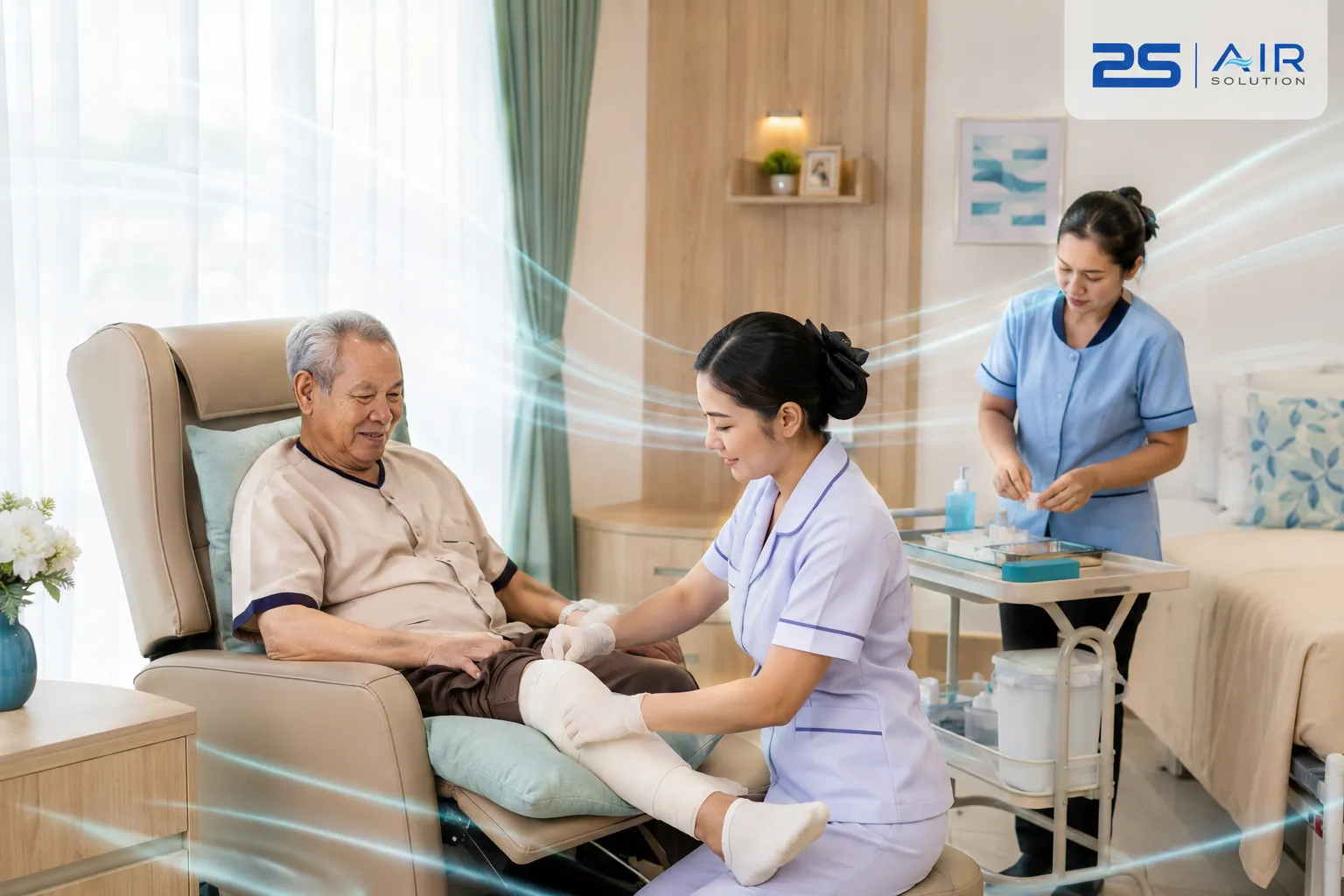
On site, the team observed two distinct patterns, differing in both intensity and source.
Type 1 — time- and location-specific: Sharp and intense during pad changes, wound dressing, and in rooms of residents with pressure sores. This odor is strong and specific — staff notice it immediately, and families notice it as soon as they enter the room.
Type 2 — accumulating over 24 hours: A baseline odor with no single obvious source, built up from many odor molecules lingering in the air of closed rooms — especially at night with no ventilation. This is what families notice the moment they open the door on a morning visit, and it is exactly what a continuous air-care system is designed to address.
Comparing common approaches in nursing homes
| Approach | Treats airborne odor | Runs continuously | Recurring cost |
|---|
| Odor sprays / air fresheners | Masks temporarily | Must reapply | High (ongoing purchase) |
| HEPA filter air purifier | Partly (good for dust, limited for VOC/odor) | Yes | Filters every 6–12 months |
| Upgrading ventilation | Helps, but requires rebuilding the system | Yes | Low, but high installation cost |
| 2S Air Solution – Cold Plasma | Acts on odor molecules directly | 24 hr continuous | Low (no annual filters — plasma tube replaced every 8,000–14,000 h) |
Solutions for nursing homes
Designed to cover the whole building, not just one room
2S Air Solution – Cold Plasma for senior care
- Runs continuously 24 hours, caring for the air at all times, including overnight
- In-duct installation in existing air-conditioning (Sanifan) — no need to tear out the system; suited to buildings with FCU systems
- Floor-standing and wall-mounted units (Tris / Miai / Globo) — covering 40 m³, 100 m³ and 150–175 m³ total volume per unit respectively, chosen by actual room size
- No filters to replace every 6–12 months — the only consumable is the plasma tube (condenser) is rated about 8,000–14,000 operating hours — roughly every 1–1.5 years when running 24/7; replaced at end of life, not monthly
- Supports existing cleaning, doesn’t replace it — staff clean as usual, with a system caring for the air 24 hours a day
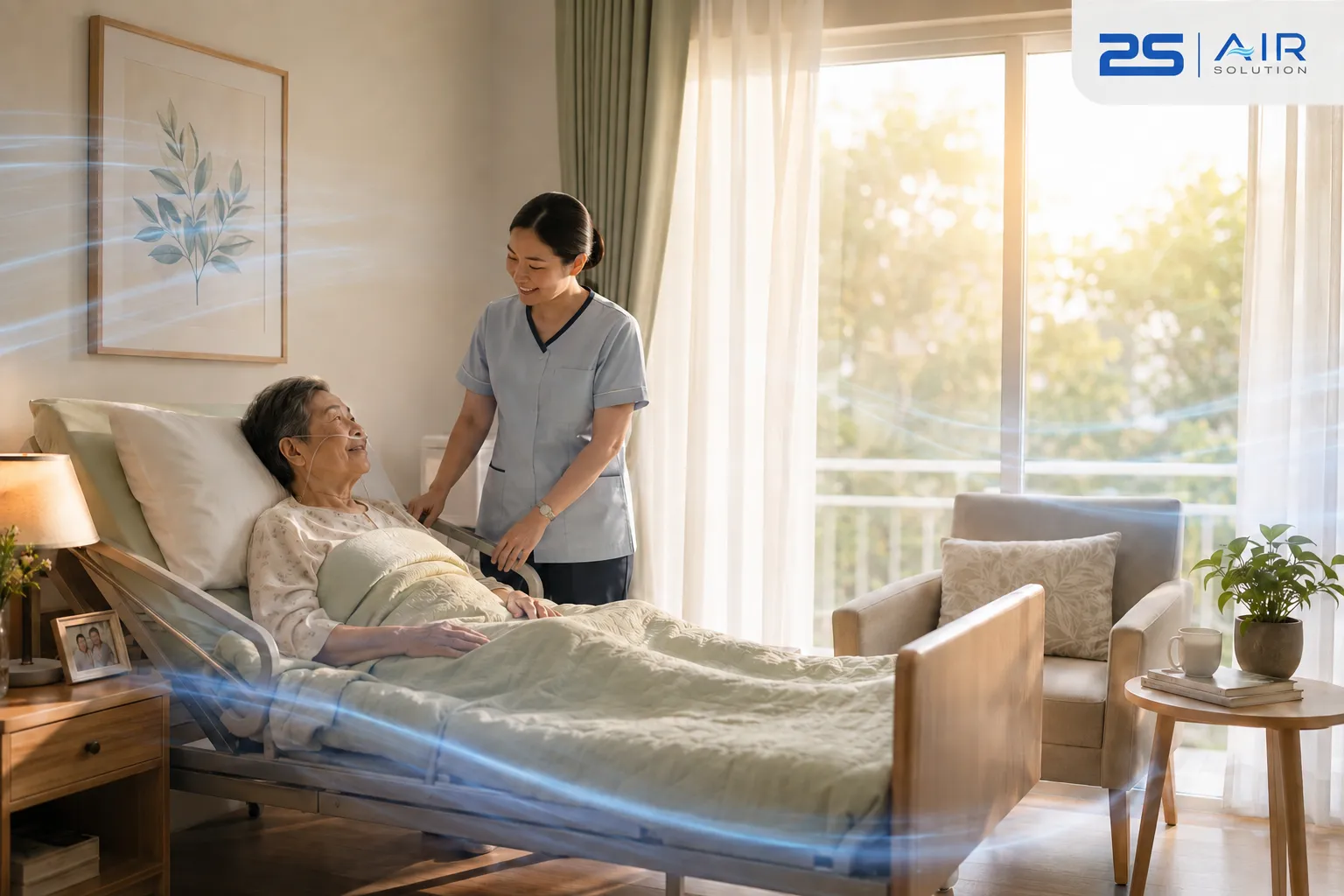
Sizing guide for nursing homes
- Shared resident rooms / common areas / dining rooms:Choose by room volume (width × length × height) — Tris for ~40 m³, Miai for ~100 m³, Globo for 150–175 m³. We recommend starting a pilot with Globo in a common area for clear results.
- Existing FCU/AHU systems (whole building):Sanifan installs directly in the duct, sized by airflow rate, with no system rebuild — suited to rollout after the pilot.
- Price:From approx. THB 25,000–64,000 per unit, depending on model and actual space.
- Start the pilot in the common area or the floor with the strongest odor, measure results, then roll out building-wide.
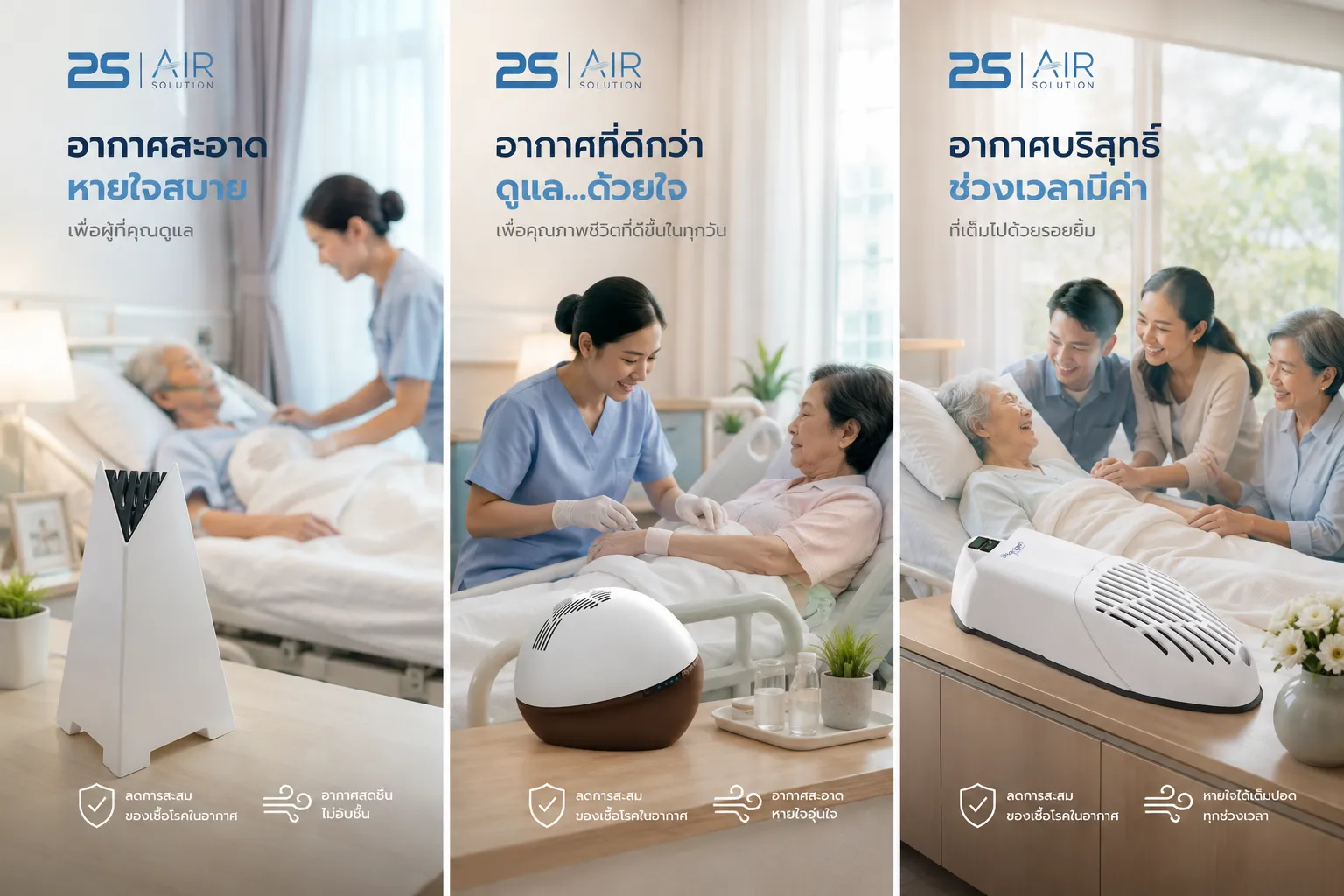
The overlooked dimension — caregivers, not just residents
When people talk about air quality in nursing homes, they think of residents. But another group spends long stretches in that environment — the care staff
Nursing home staff spend 8–12 hours per shift there. Staff who work in persistent odor all shift develop olfactory fatigue — they stop noticing the smell that families notice at the door. That’s why operators often underestimate their own facility’s odor problem, and why a constantly odorous environment is a daily burden on the people who work in it.
Not just residents — the well-being of everyone in the space
UN Sustainable Development Goal 3, “Good Health and Well-being,” isn’t only about patients or older people — it covers every person who works in that space. Investing in air hygiene is therefore not just customer service; it’s part of “People” in the 3P framework (People · Planet · Profit) that responsible businesses consider:
People — Residents get fresh air around the clock, and staff work in a more comfortable environment
Planet — No chemicals, no filter waste on a replacement cycle, no aerosol sprays
Profit — Greater confidence from visiting families, and a reputation that supports their choice of facility
Start with a pilot — measure before committing building-wide
We suggest starting with a pilot in the common area or the floor with the worst odor, comparing before and after, and gathering feedback from both staff and residents before a full rollout. Every facility has different spaces and problems, so starting from real data in your own building is the best approach.
Frequently asked questions