The Science of Odor: Why Indoor Smells Are Hard to Remove — and How to Treat Them at the Source
Key takeaways :
- Odor is made of volatile gas molecules, hundreds of times smaller than PM2.5 dust — which is why HEPA filters, built to trap particles, do not remove smell.
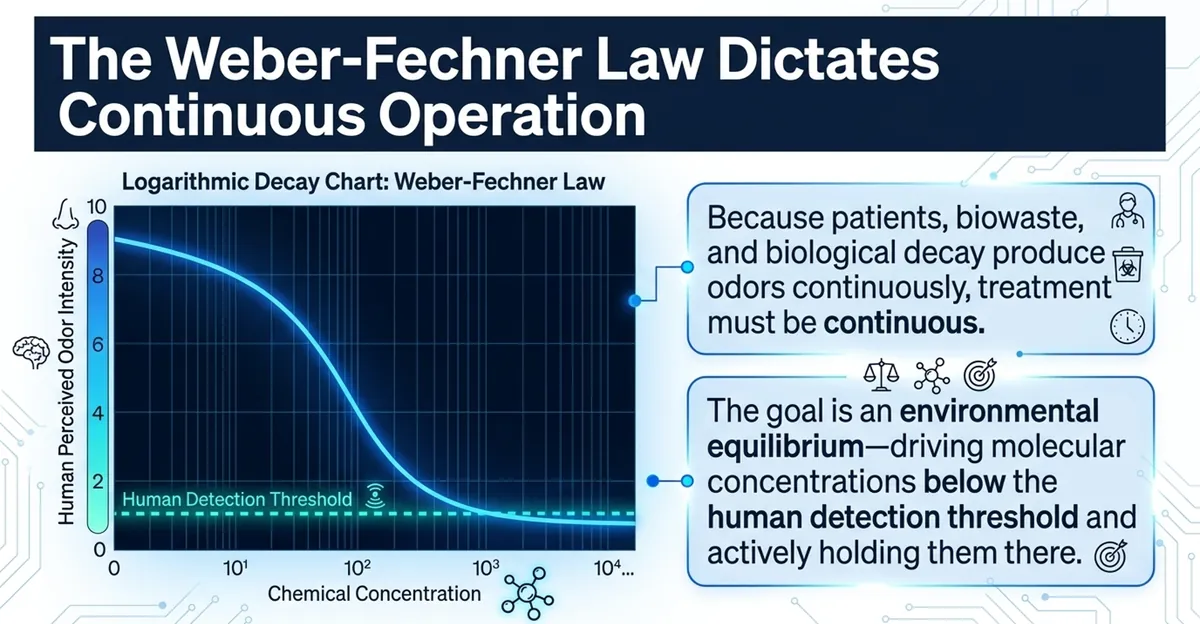
- The human nose perceives odor logarithmically, so cutting odor molecules in half is barely noticeable; levels must drop several-fold to feel cleaner.
- People who work in a space stop smelling it (olfactory adaptation), so operators routinely underestimate their own odor problem.
- Odor is hard to measure with cheap instruments — biological smells like ammonia often read near-zero on VOC meters while still smelling strong, so the human nose remains the most reliable field gauge.
- 2S Air Solution – Cold Plasma treats odor at the molecular source through oxidation, works continuously while people and animals are present, and complements existing cleaning and filtration
Odor is the first thing your customers notice — before they see anything at all. In a senior care home, a pet hotel, or any service space, smell is the sensory cue that visitors, families, and clients use to judge quality within seconds.
Yet odor is one of the hardest environmental problems to solve, because most of what people believe about “getting rid of smell” does not match the science. This article explains what odor actually is, why the usual methods fall short, and what treating odor at the source really involves.
What is odor, scientifically?
Odor is a set of volatile molecules — small, airborne compounds light enough to evaporate at room temperature. When they enter the nasal cavity and bind to olfactory receptors, the brain interprets them as smell.
The critical fact: odor molecules are gases, not particles, and they are hundreds of times smaller than PM2.5 dust. This single fact explains why so many familiar tools cannot manage smell.
Most indoor odors are biogenic — produced when bacteria break down organic matter and release specific molecules: ammonia from urine, hydrogen sulfide (the rotten-egg smell) from decomposition, and volatile fatty acids that create sweaty or rancid notes.
Why indoor odor is harder to manage than it looks
Reason 1 — The nose perceives odor logarithmically, not linearly. Under the Weber–Fechner principle, halving the concentration of odor molecules is barely perceptible. Levels have to fall by several times before a person clearly notices the air is cleaner. Good odor management therefore means holding levels below the threshold of perception continuously — not hitting zero in the first minute.
Reason 2 — Operators underestimate their own odor. The nose adapts. People who spend all day in a space gradually stop smelling it (olfactory adaptation), while a customer or family member walking in for the first time smells it fully. This gap is dangerous: a facility can have an odor problem that shapes customer decisions without the owner realizing it.
Reason 3 — The source never stops. As long as there are people, animals, or decomposition, new odor molecules are produced constantly. Odor control is not a one-time job; it is the ongoing work of keeping levels below the perception threshold — much like air conditioning must run to hold a temperature.
Where indoor odor comes from, by setting
Setting | Main odor sources |
Senior care homes | Ammonia from urine and incontinence, fecal odors, skin and pressure-wound odors, layered with medicine and disinfectant smells — in spaces that often cannot be ventilated freely |
Pet hotels & vet clinics | Concentrated ammonia from animal urine, wet-fur odor, waste, and grooming chemicals — in enclosed, high-density spaces |
Service spaces | Chemical VOCs in nail/hair salons (e.g. acetone), and cooking or grease odors in food-service areas |
Five ways to manage odor — and the catch with each
Method | How it works | Limitation |
Masking (perfume, sprays) | Adds pleasant scent over the bad one | Does not reduce the source; adds more volatile compounds to the air |
Adsorption (carbon, zeolite) | Traps odor molecules on porous surfaces | Passive — stops working once saturated |
Filtration (HEPA) | Captures dust particles | Odor molecules are gases small enough to pass straight through — HEPA is not designed to remove smell |
Oxidation (Cold Plasma) | Reacts with odor molecules so they break apart | Must be sized to the room volume and run continuously |
Biological (biofilters) | Microbes digest odor molecules | Suited to large industrial use; hard to maintain |
The most common misconception: HEPA filtration handles particles well but does not handle odor molecules. They are two different jobs — best used together, not as substitutes for each other
The truth about measuring odor: why the human nose still matters most
Many B2B buyers expect odor to be measurable with a simple before-and-after number. The reality is more complex.
In 2S field work at a senior care facility, we observed a case where a VOC meter showed almost no change while the odor in the room remained strong. The reason: the dominant smells in such settings come from ammonia and related compounds that ordinary VOC meters detect poorly — and the human nose is sensitive to these at concentrations below what affordable instruments can reliably capture.
The lesson is that instruments alone do not replace the human nose, and odor perception differs from person to person. In practice, the most credible evaluation combines sensory assessment by real people with systematic before-and-after observation in the actual space.
This is exactly why 2S recommends starting with a pilot to measure results in the real environment before rollout — rather than trusting instrument readings alone. We sell confidence you can verify, not numbers that merely sound good.
The 2S approach: treating odor at the molecular source
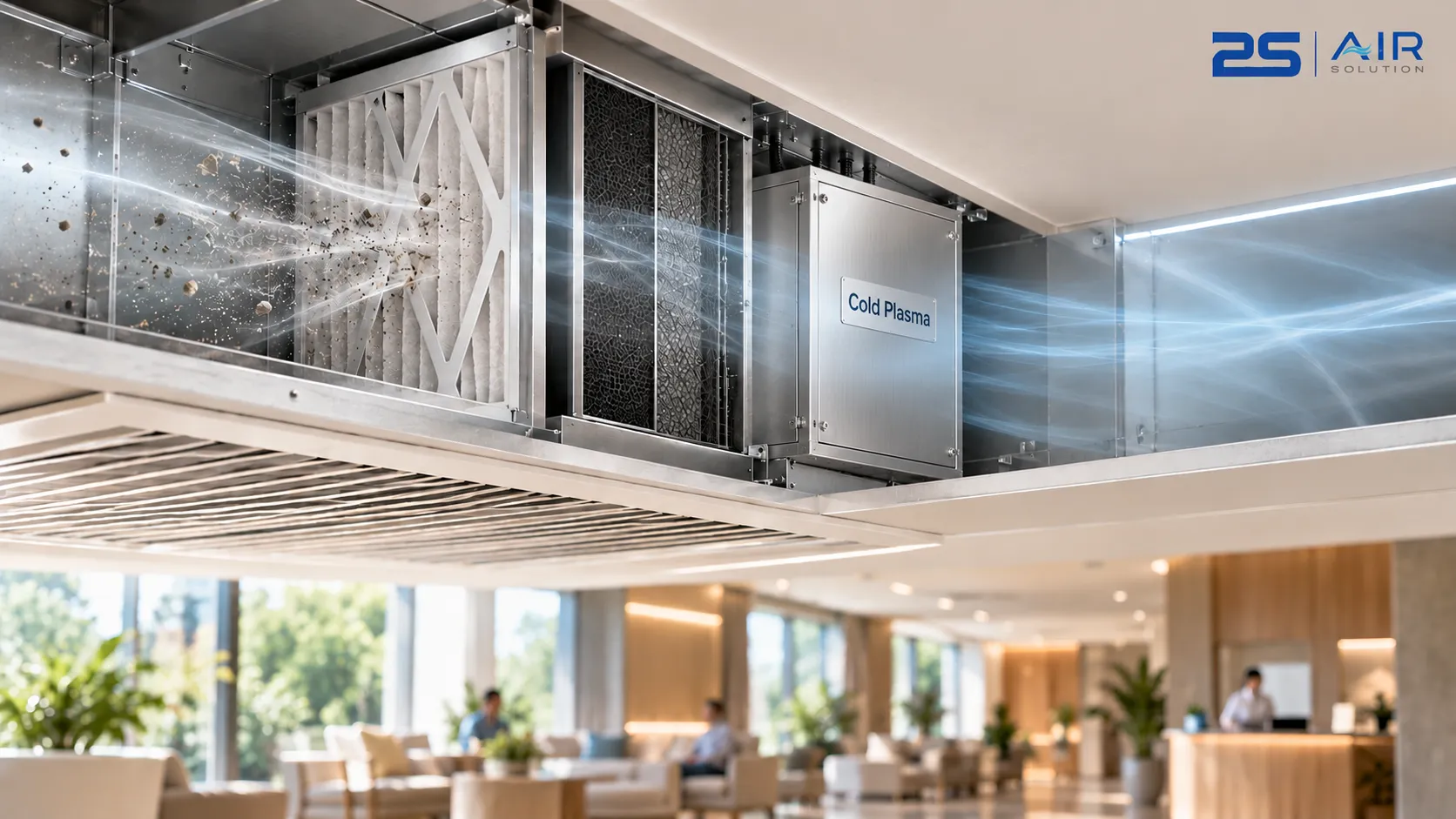
2S Air Solution – Cold Plasma works on the principle of oxidation. It generates reactions with odor molecules in the air, causing them to break down into smaller, less-odorous molecules. This treats odor at the molecular source — rather than masking it or merely trapping it.
In real-world use:
- Runs continuously while people and animals are present, keeping ozone below the 0.05 ppm standard threshold — unlike ozone generators, which require an empty room.
- Low energy use, suited to running all day.
- Complements existing systems — it works alongside your cleaning routines and existing air filtration rather than replacing them.
- Supported by controlled field data indicating a reduction in airborne bacteria (details available from our team on request).
Effective odor management requires sizing the equipment to the room volume and running it continuously to hold odor below the level the human nose perceives.
FAQ